



If hot water takes a long time to reach your sink, start by finding where the delay occurs. When the water eventually reaches the right temperature but the wait returns after a long break, look at the pipe between the heat source and the tap. A local DAFI water heater may be one option to compare if its performance and requirements suit that outlet.
First measure the waiting time and the amount of water that runs out. Then compare changes to the pipework, recirculation and a separate heater near the sink. This guide helps you prepare information for your installer and decide whether you need faster delivery, a higher hot-water flow rate, or both.
1. Why does a distant tap deliver cool water first?
Water remains in the pipe after you close the tap. During the break, it gradually loses heat to its surroundings. The next time you open the tap, this cooler water has to flow out before water from the main heater arrives. The actual pipe route, its internal diameter and the flow rate all matter.
The distance on a floor plan can be misleading. A pipe may run through a corridor, a riser and an adjoining room even though the hot-water cylinder appears close to the kitchen. Saying “it is only a few metres” therefore does not settle the question. Ask a plumber to identify the route and where it could be improved.
However, pipe length does not explain every delay. If the problem appeared suddenly, affects every tap or the water never reaches the expected temperature, have the existing heat source and installation checked. Buying another appliance should follow an assessment of the cause.
2. Measure the time, volume and conditions
Prepare a stopwatch and a graduated container. Observe the tap at its usual setting after a break, recording how long that break lasted. Note when you open it, the time needed to reach your chosen usable temperature and the volume collected. Check the temperature with a suitable thermometer. If the container is too small, use a larger one rather than interrupting the measurement and changing the flow.
Repeat after a shorter break. Keep a similar tap setting and note whether anyone used other outlets in the meantime. Comparing the first draw of the morning with the next cup rinse tells you more than a single result without any record of the conditions.
You can measure the flow rate separately by collecting water for a set period. For example, 2 litres in 30 seconds is about 4 l/min. This is a simple calculation, not a recommended flow rate for every DAFI model. Your own measurements will later help you check whether the proposed change produced the result you wanted.
In your notes, distinguish the first rise in temperature from the moment the water becomes comfortable for the task. Slightly lukewarm water may arrive earlier without meeting your expectations for washing up. Define the same endpoint before the next test. Your results will then be comparable, and the installer will understand exactly what you want to improve.
3. How much water can a pipe hold? A worked example
Assume a pipe with an internal diameter of 12 mm and a constant flow of 4 l/min. Calculate the volume of a straight length as a cylinder: cross-sectional area multiplied by length. Its approximate replacement time is the volume in litres divided by the flow rate, converting minutes to seconds.
| Pipe length | Water volume | Replacement time |
|---|---|---|
| 5 m | approx. 0.57 l | approx. 9 s |
| 10 m | approx. 1.13 l | approx. 17 s |
| 20 m | approx. 2.26 l | approx. 34 s |
This illustrates the relationship; it is not a measurement of a customer's installation or a promised hot-water arrival time. The calculation leaves out factors such as warming the pipe walls, mixing, fittings and the heat source's response. Check the real result at the tap.
If the flow falls to 2 l/min in the same example, replacing 2.26 litres takes about 68 seconds. A lower flow can therefore mean a longer wait, even though a similar volume runs out. A flow-restricting aerator does not automatically shorten the waiting time.
4. Which solutions should you compare?
Before choosing an appliance, ask for a comparison of the options for your sink. Each affects the work required, comfort and running costs differently.
| Solution | What to assess |
|---|---|
| Improve the pipe route and insulation | Whether the route can be shortened, heat loss reduced and what building work is needed. |
| Hot-water recirculation | The system layout, controls, investment and operating energy. |
| Small storage heater near the sink | Space for the tank, available reserve and reheating time. |
| Local instantaneous water heater | Flow at the required temperature, power supply and compatible tap arrangement. |
Recirculation may reduce waiting by preparing the water circuit appropriately. Controls matter: continuous operation can increase energy consumption. It needs to be assessed for the existing system, rather than treated as a universal addition to any water heater.
Insulation reduces heat loss but does not remove the water volume from the pipe. After a sufficiently long break, the water may still be cooler. For a detailed comparison of two local heat sources, read DAFI or a small storage heater for a basin or sink.
If you are renovating, discuss the pipe route before closing up walls and cabinets. In a finished kitchen, access and the amount of dismantling become more important. Request separate quotations for improving the existing installation and providing local hot water. Both should describe the result you expect. “Hot water quickly” alone is too vague to use when checking the completed work.
5. What changes when the heater is close to the tap?
A separate source near the sink lets you consider heating the water without sending it from a distant cylinder. For waiting time, the short length between the new appliance and the spout then becomes relevant. Water remains in that length too, so zero waiting should not be promised for every installation.
DAFI heats water as it flows through and does not keep a stored supply in a tank. The important question is therefore how much flow it can heat under the stated conditions. Locating it nearby helps address the delivery distance; washing-up comfort still depends on the performance of the selected variant.
Now consider what the sink is used for. Briefly rinsing a cup, filling the bowl and washing large pans create different demands. Record your most demanding routine task. For more about the location and intended use, read DAFI under the sink: when should you choose an instantaneous water heater?
6. DAFI needs the correct water feed and tap arrangement
For this comparison, consider DAFI as a cold-water-fed appliance in an arrangement that follows its instructions. The manufacturer does not intend the appliances discussed here to be used simply as booster heaters on a hot-water pipe from a boiler. Do not buy one assuming it can just be fitted in series before your existing tap.
The instructions describe open-outlet water heaters. Compatibility of the tap, connector and installation arrangement must be checked for the exact model. Two similar-looking units do not necessarily connect in the same way. Give your installer the documentation for the relevant DAFI and a photograph of the existing tap arrangement.
The IPX4 sets below, rated at 3.7 and 4.5 kW on 230 V, include a connector and shut-off valve. They show equipment to compare. The contents of the package do not establish whether your current tap is suitable or whether further components are needed to prepare the outlet.
-
Dafi water heater 3,7 kW 230 V - under...
Small single-phase Dafi Water Heater 3.7 kW 230 V with pipe connector ½ ". Dafi water heater suitable for a small sink and a hand washing. Unlike other water heaters, installing the DAFI water heater at any angle does not adversely impact its performance, and it does not damage the heating element.
79,99 €In Stock -
Dafi water heater 4,5 kW 230 V - under...
Small single-phase Dafi Water Heater 4.5 kW 230 V with pipe connector ½ ". Dafi water heater suitable sink for bathroom. Unlike other water heaters, installing the DAFI water heater at any angle does not adversely impact its performance, and it does not damage the heating element.
84,99 €In Stock


7. Faster delivery and a comfortable flow are separate criteria
At the same power, a higher flow produces a smaller temperature rise. Colder incoming water also changes the result. Bring both your waiting-time measurements and the flow and temperature needed for everyday tasks to the discussion. Include winter conditions in the assessment.
If a distant sink is used for quick rinsing, getting warm water sooner may matter more than a high flow rate. When filling a bucket, the filling time also matters. Our DAFI guide for a laundry utility sink shows how to estimate it for eight litres.
The IPX4 examples rated at 5.5 and 7.3 kW on 230 V let you compare further power options. Selecting them requires an assessment of the electrical installation by a qualified person. A socket under the sink alone does not confirm that connection is possible. Also distinguish the 7.3 kW, 230 V variant from the 7.5 kW, 400 V version.
Ask for performance under stated conditions: inlet temperature, desired outlet temperature and flow. That comparison will still be useful if your comfort requirements call for a different solution. The DAFI power selection guide explains the relationships.
-
Dafi water heater 5,5 kW 230 V - under...
Small single-phase Dafi Water Heater 5.5 kW 230 V with pipe connector ½ ". Dafi water heater adapted kitchen sink. Unlike other water heaters, installing the DAFI water heater at any angle does not adversely impact its performance, and it does not damage the heating element.
89,99 €In Stock -
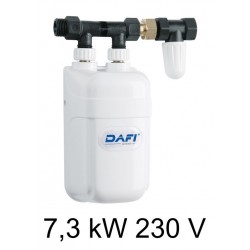
Dafi water heater 7,3 kW 230 V - under...
Small single-phase Dafi Water Heater 7.3 kW 230 V with pipe connector ½ ". Dafi water heater suitable for shower and sink / shower together. Unlike other water heaters, installing the DAFI water heater at any angle does not adversely impact its performance, and it does not damage the heating element.
94,99 €In Stock

8. How can you assess the water volume and financial case?
Take a separate example: you collect 2 litres during one wait, and the same situation occurs after the pipe cools down 10 times a day. That is 20 litres a day and 600 litres, or 0.6 m³, over 30 such days. These are calculation assumptions. Do not multiply every tap opening by the full volume if the pipe stays warm between draws.
Calculate the cost of water and wastewater using your own tariff and billing arrangement. Compare energy, the appliance, taps, installation and any electrical work separately. The new heater uses energy to heat water; a shorter wait does not automatically mean a lower total bill.
Consider convenience too: how often is your work interrupted, and does the problem affect only one outlet? If comfort is the priority, state that clearly. The guide to DAFI electricity and water consumption explains the distinction between power, energy and volume.
9. What should you ask the installer and check afterwards?
Prepare a short description of the problem. It will help you compare quotations based on the same requirements:
- Which tap is affected, and after how long a break?
- How long is the wait, and how much water flows out?
- What flow and temperature do your routine tasks need?
- What is the pipe route, and which source currently supplies it?
- What are the cabinet dimensions, tap type and power-supply possibilities?
- What does the proposed solution include, and what is the full installed cost?
When the work is finished, repeat the same observation method. Record the conditions, time, volume and comfort during an actual task. Do not compare the first draw after a whole night with a test immediately after rinsing dishes. Also ask for an operating demonstration, access to the valve and the installed appliance's documentation.
10. How can the results help you decide?
The first draw is slow, the next noticeably quicker. This gives you a reason to investigate pipe cooling and volume. Compare alterations, insulation, an assessment of recirculation and a separate source near the sink. It is a direction for further investigation, not a fault diagnosis based on one test. Record the length of both breaks too.
Hot water arrives quickly, but the hot flow is insufficient during use. Performance at your required flow becomes the priority. Moving the heater closer to the tap does not give it more power. Show the installer the task that is uncomfortable with the present system and ask for a comparison under those conditions.
Results have changed suddenly or are very unstable. Start by having the installation and existing source checked. Note whether the bathroom has a similar problem and whether it coincides with other appliances being used. Separate the cost of diagnosis from possible improvements so that you do not order a heater before the cause is clear.
To compare specific DAFI sets, send us a description of the outlet and your observations. A suitable choice follows from understanding the cause of the wait and your needs at the tap. Those details make it possible to assess whether a local heater is the right solution.