



In some installations, a small 5, 10 or 15-litre storage water heater can be replaced with a DAFI instantaneous water heater. A successful change depends on the flow and temperature you need, the available electrical supply and the compatibility of the complete arrangement with the tap. Freeing up cupboard space alone does not tell you whether the new solution will provide the comfort you expect.
If your current heater is worn out, takes up too much room or no longer suits your habits, use the replacement as an opportunity to reassess the water point. This guide concerns an existing washbasin or sink. It helps you prepare a comparison and discuss the work with an installer before ordering.
1. Decide what replacing the heater should improve
Start with a specific problem. Do you need more room for cleaning products? Does the hot water run out during a longer washing-up session? Or does the heater work properly, with replacement simply being considered as part of a kitchen renovation? Each reason calls for a slightly different comparison.
Record the current model, capacity and power rating from an accessible label or the paperwork. Photograph the whole cupboard, the tap and visible connections without removing covers. Explain whether the heater supplies one tap and whether pipework or tap fittings have been changed. Photos help prepare a quotation; the technical assessment is the professional’s responsibility.
During a normal day, note how you use hot water and what is inconvenient. “I want to rinse a large saucepan comfortably” is more useful than “I need a powerful heater”. Also identify what you want to keep: your existing tap, cupboard space or your usual way of washing dishes.
If a sudden change in operation prompted the replacement, establish its cause first. Reduced flow or problems appearing after plumbing work can also involve other parts of the water point. Buying a new heater without understanding the problem does not guarantee an improvement. If there is a leak or suspected damage, stop using the equipment and contact a professional.
2. Why does a 10-litre tank not correspond to one DAFI power rating?
A storage heater holds a reserve of heated water. You draw from that reserve while the tap is open, and the appliance needs time to replenish it once it is used up. The amount of water available at your preferred tap temperature also depends on the setting and mixing with cold water. Tank capacity alone does not describe the full experience.
DAFI heats water as it flows through the appliance. There is no tank that gradually empties, but a set amount of heating power is available at any moment. The resulting temperature depends on flow and inlet water temperature. At the same power rating, a higher flow gives a smaller temperature rise.
There is therefore no simple conversion such as “10-litre tank = DAFI of a particular power”. Compare the water you want from the tap, including in winter. Our guide to DAFI versus a small storage heater for a washbasin or sink explains the general differences. Replacing an existing appliance also requires checking compatibility with what is already fitted.
3. Check the flow you use every day
Brief handwashing, rinsing a cup and filling a sink are different needs. Notice whether you usually run a moderate stream for a few seconds or need a larger volume continuously. The temperature you expect matters as much as the time the tap stays open.
Describe your normal use of the working installation to the installer. If you collect water in a container to measure flow, avoid hot water and do not alter the installation’s settings for the test. A result in litres per minute is more helpful than “the tap halfway open”.
Compare that result with the chosen appliance’s data, taking account of the conditions stated alongside its performance figures. Water entering the home in winter may be colder than the water used for catalogue conditions. Our DAFI power selection guide can help. The two complete under-sink kits below are examples to compare, rather than automatic replacements assigned to a tank capacity.
-
Dafi water heater 3,7 kW 230 V - under...
Small single-phase Dafi Water Heater 3.7 kW 230 V with pipe connector ½ ". Dafi water heater suitable for a small sink and a hand washing. Unlike other water heaters, installing the DAFI water heater at any angle does not adversely impact its performance, and it does not damage the heating element.
79,99 €In Stock -
Dafi water heater 4,5 kW 230 V - under...
Small single-phase Dafi Water Heater 4.5 kW 230 V with pipe connector ½ ". Dafi water heater suitable sink for bathroom. Unlike other water heaters, installing the DAFI water heater at any angle does not adversely impact its performance, and it does not damage the heating element.
84,99 €In Stock


4. Can you keep the existing tap?
This is one of the most important questions before buying. Small storage heaters come in different hydraulic arrangements. Two appliances beneath similar sinks may need different tap fittings. The tap’s appearance, the number of visible hoses or a matching thread does not confirm compatibility.
DAFI documentation describes open-outlet water heater configurations. In such an arrangement, free discharge must be maintained as required by the diagram for that specific version. Do not transfer the old tank’s connections to the new appliance simply by connecting it “the same way”. The shut-off valve and connector have defined functions; their presence does not replace checking the tap.
Ask the installer to confirm whether the existing tap can remain, which components need replacing and which manufacturer’s diagram applies. Provide the old heater’s manual if you have it, together with the documentation for the DAFI you are considering. Our guide to DAFI water connections and tap fittings explains this part of the assessment.
When replacing a storage water heater, you may also consider a tap with a built-in heating element. Include it as a separate option in the quotation and have compatibility with the existing installation confirmed for the specific model. Our guide to what to compare when choosing an under-sink water heater or electric heated tap will help you assess documentation, convenience and the cost of the complete setup, including the necessary tap fittings and installation work.
5. Have the existing electrical supply reassessed
Even if both appliances operate at 230 V, their supply requirements may differ. Do not assume that the socket used by the storage heater is suitable for the chosen DAFI. An electrician should assess the exact model, circuit and installation conditions, including other appliances operating at the same time.
Give the electrician the full kit name and power rating, rather than just describing it as a “small water heater”. The under-sink range includes 3.7, 4.5, 5.5 and 7.3 kW models at 230 V. Moving up a power rating can change the work required. For a home in France, the contracted supply capacity in kVA shown on the electricity bill is also useful information.
If the assessment shows that the intended power requires substantial alterations, return to comparing the options. A lower-powered DAFI makes sense only if it can provide the flow and temperature needed. The two higher-powered kits below show further variants. Choose according to the water point’s requirements and the installation assessment.
-
Dafi water heater 5,5 kW 230 V - under...
Small single-phase Dafi Water Heater 5.5 kW 230 V with pipe connector ½ ". Dafi water heater adapted kitchen sink. Unlike other water heaters, installing the DAFI water heater at any angle does not adversely impact its performance, and it does not damage the heating element.
89,99 €In Stock -
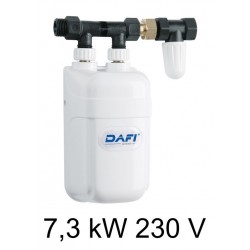
Dafi water heater 7,3 kW 230 V - under...
Small single-phase Dafi Water Heater 7.3 kW 230 V with pipe connector ½ ". Dafi water heater suitable for shower and sink / shower together. Unlike other water heaters, installing the DAFI water heater at any angle does not adversely impact its performance, and it does not damage the heating element.
94,99 €In Stock

6. Allow space for the complete installation
Removing the tank may free space beneath the sink, but the appliance dimensions are only the starting point. The waste trap, connections and pipework remain in the cupboard. Access to isolation points and room for inspection and maintenance specified in the manual are still needed.
Measure usable space with the doors closed, allowing for drawers, the waste bin and items you intend to store. Show the installer a photo with a measuring tape. Agree the position before ordering equipment, particularly if the furniture is also changing. A small casing does not mean unrestricted freedom to install it anywhere.
Include the water’s route from appliance to tap in the replacement plan. Moving the source further away during renovation changes the conditions of use. Ask what parts of the old arrangement will remain and how access will work once the job is finished. A sketch helps settle these details before buying furniture and equipment.
7. Compare replacement and running costs
Request two comparable quotations: replacement with a suitable small storage heater and a change to the chosen DAFI. Each should include the appliance, tap fittings, materials, plumbing and electrical work, commissioning and removal of the old equipment. This helps reveal whether an attractive purchase price comes with a larger adaptation job.
For energy costs, distinguish power from consumption. For example, an appliance drawing 4.5 kW for a total of 10 minutes uses approximately 0.75 kWh. This is a calculation based on an assumed heating time, not a measurement of your installation. Multiply the result by your own price per kWh to estimate the energy cost.
Specify the same intended result in both quotations, such as comfortable dish rinsing at a defined flow. The price of a storage heater alone, keeping existing connections, is not directly comparable with a complete conversion for DAFI. Ask what is excluded and whether the old appliance will be taken away. A clear scope helps identify extra costs absent from the initial comparison.
A comparison with the storage heater needs its actual data and similar water-use habits. Consider maintaining the stored reserve, the volume drawn and any change in electricity subscription cost. Removing the tank removes the need to keep water hot inside it, but that alone does not establish a particular saving on the total bill.
Want to estimate your energy cost after replacing a storage water heater? Use the electricity consumption and cost calculator in article 29. Enter the power of the DAFI model you are considering, the total heating time and your own price per kWh. The estimate reflects those assumptions; it excludes purchase, installation, standing charges and water, and does not calculate savings compared with the storage heater.
8. Two situations that may lead to different decisions
A washbasin used briefly several times a day. Suppose an existing 5-litre heater occupies useful cupboard space and the user wants a moderate flow for handwashing. A local instantaneous heater is worth assessing. After checking performance, supply and tap compatibility, compare the complete kit cost with buying another storage heater.
A sink used for longer washing-up sessions. In the second example, a 15-litre heater serves large saucepans and the household values a generous hot-water stream. Saving space is not enough to make the decision. First establish the required flow and check whether a DAFI permitted for that installation can supply it at the desired temperature. If not, a suitably selected tank may meet expectations better.
These examples illustrate a way of making the decision; they are not accounts of customer installations. The 5 and 15-litre capacities describe the starting point without automatically determining a suitable replacement.
| What you observe | What it means for the comparison |
|---|---|
| Short draws with long breaks | Assess DAFI against the flow actually needed. |
| A high flow is required | Compare performance, temperature and available power before deciding. |
| You want to retain the tap | Confirm compatibility of the entire hydraulic arrangement. |
| The change needs major work | Compare the full adaptation cost with fitting another storage heater. |
9. Prepare the information needed for a quotation
A brief, organised description makes it easier to obtain advice relevant to your water point. Use this checklist and add questions alongside anything you do not know:
- Current heater model, capacity and power, and the reason for replacement.
- A photo of the location, accessible markings and existing tap.
- Tap use, frequency of draws and desired flow.
- Available dimensions and components you want to keep.
- The exact DAFI kit under consideration, with its product link.
- Work scope, complete replacement cost and agreed commissioning arrangements.
You do not need to select cables, protective devices or adapters yourself to prepare an enquiry. Our installation preparation checklist before buying DAFI can help. If the offer you are viewing is a heating element rather than a complete appliance, also consult the guide to identifying DAFI models and spare parts.
10. Check the finished water point against everyday use
After installation, ask the professional to inspect and commission the assembly according to the applicable manual. DAFI documentation requires preparation and removal of air from the water circuit before the appliance is energised. Keep the manual, the installed model details and the information about the tap and other components.
Check how to use the tap at the flow you need and ask for a demonstration of temperature adjustment. Find out which maintenance tasks are intended for the user and who to contact if operation changes. Handover is also a good time to confirm that the necessary access remains available with the cupboard closed.
If you are considering replacing a small storage heater, send the DAFI shop your existing appliance details and a description of your needs. This makes it easier to compare appropriate offers. A sound decision considers comfort at the tap, installation compatibility and the cost of the complete water point together.