



DAFI can be considered as a source of hot water for a bath, but comfort depends on the exact model, the flow it can provide and the filling time you are willing to accept. A small casing and the word “instantaneous” do not mean that any volume of water can be prepared quickly. Start with a simple question: how many litres do you want to run, and how long can you wait?
For an example volume of 100 litres and the flows in the table below, the calculated time is about 17–35 minutes. This compares specific variants under defined conditions, rather than promising a result in your bathroom. Before buying, check the figures against the model's instructions, the cold-water inlet temperature and the capabilities of your plumbing, tap and electrical installation.
1. A bath needs a particular volume of water
In a shower, you use the flowing water straight away. With a bath, you usually wait until enough water has collected. A flow suitable for briefly washing your hands can mean a long wait to fill a bath. Washbasin, shower and bath applications should therefore be assessed separately.
An instantaneous heater warms water as it is drawn and does not keep a reserve in a tank. Its performance depends on the combination of flow and temperature rise. Removing the tank does not remove the limits of the available power: the appliance must supply energy to each litre passing through it.
Decide on your priority first. Do you want to fill the bath regularly in a short time, or are you looking for an occasional bathing solution and happy to accept a slower flow? Write this down before comparing offers. If you mainly use a shower, also read our guide to assessing DAFI for a shower.
2. Calculate the time from volume and flow
A simple calculation provides a starting point: time in minutes = volume in litres ÷ flow in litres per minute. For 100 litres at a steady 4 l/min, the result is 25 minutes. At 2 l/min, the same volume takes 50 minutes.
The following table uses example volumes and the total flow entering the bath. These are calculation scenarios, rather than performance figures assigned to particular heaters.
| Water volume | At 2 l/min | At 4 l/min | At 6 l/min |
|---|---|---|---|
| 80 l | 40 min | 20 min | approx. 13 min |
| 100 l | 50 min | 25 min | approx. 17 min |
| 120 l | 60 min | 30 min | 20 min |
Choose a volume that reflects how you use your bath. The capacity in the bath manufacturer's catalogue does not necessarily equal the amount run before each use. We deliberately include several volumes rather than assuming one standard level of consumption for everyone.
You can also work backwards from your requirement. To run 100 litres in 15 minutes, you need an average of about 6.7 l/min at the desired temperature. If half an hour is acceptable, about 3.3 l/min is enough. These figures describe two different expectations for the same volume. They give the seller and installer a clear requirement instead of a general request for a “powerful bathroom water heater”.
3. What do the figures for these DAFI models show?
In the manufacturer's table for under-basin heaters, the flows relate to incoming water at 15°C and a pressure of 200,000 Pa, or 0.2 MPa. We show four variants offered in the shop. The outlet temperatures of 40°C and 45°C are reference points for comparing their performance.
| DAFI IPX4 variant | Flow at 40°C | Flow at 45°C | 100 l at 40°C — calculation |
|---|---|---|---|
| 5.5 kW / 230 V | 2.9 l/min | 2.5 l/min | approx. 35 min |
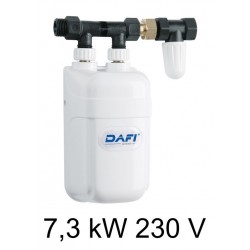
| 7.3 kW / 230 V | 4 l/min | 3.3 l/min | 25 min |
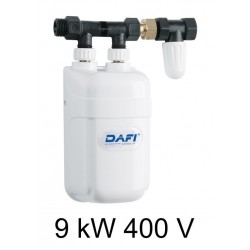
| 9 kW / 400 V | 4.7 l/min | 4 l/min | approx. 21 min |
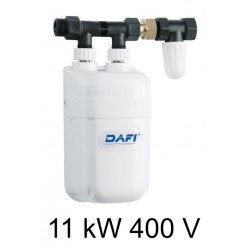
| 11 kW / 400 V | 5.8 l/min | 5.1 l/min | approx. 17 min |
The last column is calculated by dividing 100 litres by the stated flow. It is not a measured bath-filling test. It assumes a constant flow at the stated temperature, with no cold water added and no allowance for cooling in the pipes or bath. The heater's flow rating does not guarantee that all the collected water will have the same temperature.
Even the highest flow in this table does not imply that 100 litres can be run in ten minutes. That would require an average of 10 l/min at the appropriate temperature. This is a useful example of checking your needs before ordering.
Changing the outlet temperature changes the result too. For the 11 kW variant, the stated 5.1 l/min at 45°C gives a calculated time of about 20 minutes for 100 litres, rather than about 17 minutes at 40°C. For the 7.3 kW variant, dividing by 3.3 l/min gives about 30 minutes. Both comparisons still assume incoming water at 15°C, rather than any possible conditions.
The 230 V kits below illustrate two levels of flow. Comparing them does not mean that each one is suitable for your bath. A heater, connector and shut-off valve do not confirm compatibility with every bath tap or mixer.
-
Dafi water heater 5,5 kW 230 V - under...
Small single-phase Dafi Water Heater 5.5 kW 230 V with pipe connector ½ ". Dafi water heater adapted kitchen sink. Unlike other water heaters, installing the DAFI water heater at any angle does not adversely impact its performance, and it does not damage the heating element.
89,99 €In Stock -
Dafi water heater 7,3 kW 230 V - under...
Small single-phase Dafi Water Heater 7.3 kW 230 V with pipe connector ½ ". Dafi water heater suitable for shower and sink / shower together. Unlike other water heaters, installing the DAFI water heater at any angle does not adversely impact its performance, and it does not damage the heating element.
94,99 €In Stock

4. Check the inlet temperature in winter
Heating water from 15°C to 40°C requires a temperature rise of 25 degrees. With incoming water at 5°C, reaching the same outlet temperature requires a rise of 35 degrees. At the same power, the heater must then put more heat into each litre. Do not assume that a flow quoted for a 15°C inlet will remain available in winter.
This matters when planning baths throughout the year. A result achieved in summer does not confirm identical operation during the coldest weeks. Before speaking to your installer, prepare the actual or expected supply-water temperature and the flow you would like.
If you can only reach the desired temperature by reducing the flow, allow for a longer filling time. Return to the first table and use the appropriate figure to compare scenarios. Our article on adjusting DAFI water temperature through flow explains this relationship in more detail.
5. Opening the tap further does not increase the heater's power
A higher flow can fill the bath faster while reducing the temperature rise. If cooler water enters the bath, reaching the required water level quickly does not mean achieving the comfort you expected. Always compare volume and temperature together.
Mixing water needs similar care. Adding cold water changes the total volume and the temperature of the mixture. You cannot then calculate the filling time as though every litre had passed through the heater. The model table shows a simpler case: the whole flow being considered has the stated outlet temperature.
During a long fill, some heat passes into the bath and the surroundings. There is no universal number of extra minutes that accounts for this in every bathroom. It depends on the conditions and the bath itself. Leave a margin when judging comfort rather than treating the division as an exact time for preparing your bath.
6. Choose the power alongside the installation
The 5.5 and 7.3 kW variants in the table use 230 V, while the 9 and 11 kW variants use 400 V. These are different appliances with different requirements. Do not choose a more powerful model solely because its calculated filling time is shorter. An electrician should first assess whether the exact version can be connected.
An existing socket or a 230 V label does not confirm that the current circuit is suitable. For 400 V, the actual supply arrangement, connections and protective devices must also be checked for the appliance and installation. The power available in the building and other appliances running at the same time matter when assessing the whole solution.
Prepare the variant reference, a photograph of the rating plate or the exact kit listing. Our guide to choosing DAFI power helps you organise the questions. The 9 and 11 kW kits below are also described in the shop for bath applications, but choosing them still requires an assessment of flow, tap compatibility and installation conditions.
-
Dafi water heater 9 kW 400 V - under sink...
Small biphase Dafi Water Heater 9 kW 400 V with pipe connector ½ ".Dafi water heater suitable for bath and sink / tub combinations. Unlike other water heaters, installing the DAFI water heater at any angle does not adversely impact its performance, and it does not damage the heating element.
104,99 €In Stock -
Dafi water heater 11 kW 400 V - under sink...
Small biphase Dafi Water Heater 11 kW 400 V with pipe connector ½ ".Dafi water heater suitable for bath and sink / tub combinations. Unlike other water heaters, installing the DAFI water heater at any angle does not adversely impact its performance, and it does not damage the heating element.
109,99 €In Stock
7. Bath tap compatibility is a separate question
The instructions describe DAFI as an open-outlet water heater. Do not automatically treat it as a replacement for any pressurised storage heater. The existing bath tap or mixer, shower diverter and pipe arrangement need to be checked for the exact configuration.
Show the plumber the instructions for the chosen version, a photograph of the tap and the proposed appliance position. Agree what can stay and what needs to be selected. The description “kit with connector” does not define the equipment for the whole bathroom or approve connection to every mixer tap.
The position of the appliance also depends on its documentation and the installation conditions. Do not choose it solely from the IPX4 rating or the space that happens to be available. Our guide to choosing where to install DAFI covers this subject. Before ordering, have both the heating capabilities and the permitted connection arrangement assessed.
Also check that the appliance and parts requiring attention remain accessible after any boxing-in is completed. A small casing does not mean it can be enclosed in any recess without consequences. A quotation based only on a heater photograph may leave out work on the tap, water supply or electrical supply. Clarify these items before choosing an offer.
8. Gather information without altering the installation
With existing fittings in good working order, you can observe how long it takes to run a known volume into a container. Two litres collected in 30 seconds equal a flow of 4 l/min. This describes your current water point. It does not prove that a new heater will provide the same flow with the required temperature rise.
Record whether the observation concerns cold, hot or mixed water and how the tap is set. Do not alter connections or protective devices for the measurement. If the installation is not working properly, have its condition checked first.
Describe a typical evening as well. Does someone use the kitchen sink while the bath is filling? Do several people want baths one after another? Do not assign the table's flow to each tap separately or assume that a model chosen for one outlet will serve any multi-outlet arrangement. This information can change both the assessment of comfort and how the whole installation should be prepared.
- Define the intended water volume and maximum acceptable wait.
- Describe how often baths are taken and whether other taps run at the same time.
- Prepare photographs of the fittings, available space and chosen model reference.
- Ask for an assessment of the water and electrical conditions for this solution.
- Establish the cost of the complete water point, including the work required.
9. Compare comfort and the cost of the whole bath
Higher power means greater energy use per unit of time, but it can shorten the time needed to heat the same volume of water. The kilowatt figure alone does not determine the cost of a bath. Volume, temperature rise, actual running time and energy price matter too.
When comparing a storage heater, consider its usable reserve, whether it can supply the desired water volume and how long it needs to prepare the next bath. Include the space required, tap equipment and installation work. Leaving out these items can reverse a seemingly simple choice based on the appliance price alone.
Ask for solutions to be compared for the same task: a similar volume, inlet temperature and acceptable waiting time. A lower purchase price for an appliance that cannot provide the required comfort does not settle the calculation. A more expensive installation should, in turn, offer a benefit that matters to you. Do not base the assessment on a promised percentage saving supposed to suit every bath and pattern of use.
10. When is DAFI worth considering for a bath?
It is worth comparing an exact model if you accept the filling time resulting from the conditions, the installation can support its connection, and the fittings and position comply with its documentation. Occasional bathing can involve different priorities from a home where several people use the bath daily.
If you require a high flow and a very short wait, explain that before buying and compare other solutions. A good choice matches volume, temperature and time to the capabilities of the complete water point. Ask about a specific DAFI kit and provide the information you have gathered. This makes it easier to compare the available variants on a useful basis.
Frequently asked questions about DAFI for baths
Is a 7.3 kW DAFI enough for a bath?
For 100 litres in 20 minutes, you need an average flow of 5 l/min at your chosen temperature. With water at 15°C at the inlet, 40°C at the outlet and a test pressure of 0.2 MPa, the manufacturer lists 4 l/min for the 7.3 kW DAFI. At that steady flow, 100 litres takes 25 minutes. If that suits you, check the manual to see whether the model is suitable for this use and your tap.
When should you consider 9 or 11 kW?
Under the same conditions, the 9 kW model is rated at 4.7 l/min, or about 21 minutes for 100 litres. At 5.8 l/min, the 11 kW model takes about 17 minutes. Only the 11 kW model exceeds the required 5 l/min in the test. The 7.3 kW model runs on 230 V and the 9 and 11 kW models on 400 V. Before buying, have an electrician check your installation against the model’s manual.
How can you estimate your own filling time?
In the power and flow calculator, choose “Theoretical flow rate”. Enter the model’s power, the inlet water temperature and the target temperature at the heater outlet. If the heater is installed, divide the planned volume in litres by the actual flow in l/min. Measure at the tap using your usual filling setting, including when mixing hot and cold water.